

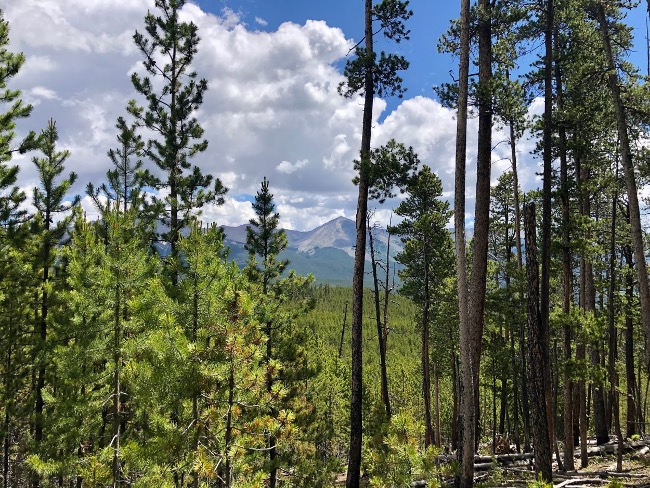
Photo Credit: Kirsten Martin, Colorado State University.
- Increase species, structural diversity, & spatial heterogeneity
- Maintain lodgepole pine as dominant species
- Prevent or reduce establishment of invasives
- Promote water storage and organic soil retention
- Increase resilience to fire and pest
- Retain some wildlife trees/character trees
- Maintain access to roads for recreation & operation
- Maintain Engelmann Spruce & Subalpine Fir to protect goshawk habitat and nesting sites
- Maintain snags for wildlife / cavity nesting Protect heritage sites
- Variable density thinning (a.k.a 2-cut Group shelterwood)
- Seed cut; removal cut (20-40 yrs.)
- Reserves in clumps for wildlife E.g., spruce, legacy trees, snags, etc.
-
- 180-300/100 acres of 8” DBH or greater (1-3/ac)
-
- 1–5-acre gaps for snow retention; irregularity for edges (curved); 2 or 3 landings per unit based on skidding needs
- Density reduction throughout the matrix: 80-90 ft for tree length
- No harvest on existing spruce and fir
- Regenerate every 10-20 years
- Plant Douglas-fir (matrix & gaps), blister rust-resistant limber pine (gaps), Engelmann spruce – local seed (in gaps & matrix). Genotypes: Drought-tolerant southern seed sources (limber & Douglas-fir)
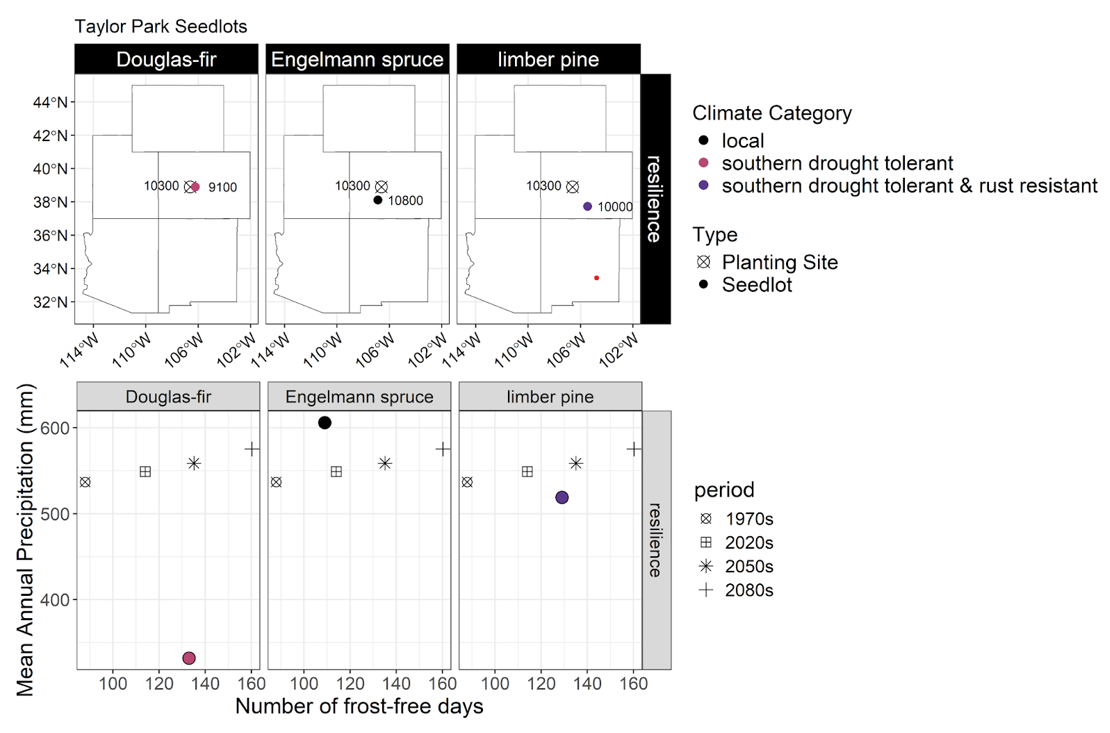
The seedlots that will be used for Douglas-fir, Engelmann spruce, and limber pine reforestation in the resilience treatment will come from nearby populations, as shown on the maps. They all come from areas with average 1970’s climates that are warmer than the planting site and have similar or less precipitation, as indicated in the plots. The “period” corresponds to the climate projections for the average number of frost-free days and mean annual precipitation at the planting site in the 30 years centered on the 1970’s, 2020’s, 2050’s, and 2080’s. Numbers next to the seedlots on the map show the elevation in feet that the seedlot is from.
- Weeding around seedlings for establishment
- Utilize biocontrols for invasive plants



Jonathan Coop
Taylor Park ASCC Site Lead
Professor of Environment and Sustainability
Western Colorado University
Gunnison, CO 81231
Phone: 970-943-2565
Jcoop@western.edu
Mike Battaglia
Taylor Park ASCC Site Co-Lead
Research Forester
USDA Forest Service, Rocky Mountain Research Station
Forest and Woodland Ecosystems Science Program
240 West Prospect Road
Fort Collins, CO 80526
Phone: 970-498-1286
Michael.battaglia@usda.gov

Carlyn Perovich
Taylor Park ASCC Site Co-Lead
Ecologist
USDA Forest Service, Grand Mesa, Uncompahgre and Gunnison National Forests
2250 S Main St, Delta, CO 81416
Phone: 720-656-8655
carlyn.perovich@usda.gov

Art Haines
Taylor Park ASCC Site Co-Lead
Silviculturist
USDA Forest Service, Grand Mesa, Uncompahgre and Gunnison National Forests
Gunnison Ranger District
216 No. Colorado St
Gunnison, CO 81230
p: 970-642-4423
Arthur.haines@usda.gov

Lauren Rupiper
Taylor Park ASCC Site Co-Lead
Timber Management Assistant
USDA Forest Service, Grand Mesa, Uncompahgre and Gunnison National Forests
Gunnison Ranger District
216 No. Colorado St
Gunnison, CO 81230
c: 970-765-4106
lauren.rupiper@usda.gov