Simulating ASCC implementation in the Rocky Mountains – some initial thoughts on a modeling experiment
Written by Neil Williams, Postdoc with USFS Rocky Mountain Research Station / ORISE
Planning for an uncertain future can take many forms. In the ASCC network, experimental treatments designed to adapt forests to an uncertain future climate were developed through expert opinion informed by the best available science. Forest modeling is another way of assessing possible futures and testing alternative courses of action – and doing so with significantly less risk than decisions over which trees to harvest or what species to plant. At the ASCC sites, forest models can be used to simulate stand dynamics in response to prescriptions resembling our control, resistance, resilience, and transition treatments. With additional assumptions, model logic, and code, these models can be adjusted to simulate the effects of and potential responses to climate change. These simulations can provide valuable insights into the potential effectiveness of our adaptation treatments and are complementary to the expert opinion-based process. Over the past year, I have been working with Mike Battaglia, Justin Crotteau, and Lance Asherin (research foresters with the U.S. Forest Service, Rocky Mountain Research Station) on a project that does just this. In this post I provide some thoughts on the modeling process as we enter the second half of the project.
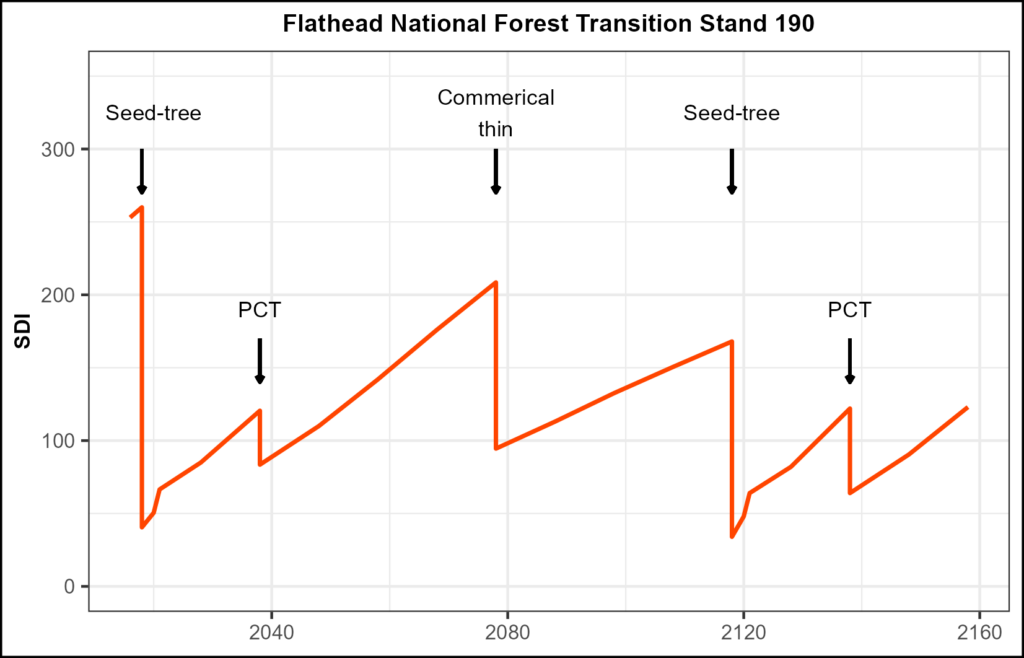
Working on the four ASCC sites in the U.S. Rocky Mountains – the Flathead National Forest in Montana, and the Colorado State Forest, Taylor Park, and San Juan National Forest in Colorado – we are using the Forest Vegetation Simulator (FVS) to model trajectories of forest stand development with and without climate change. These sites feature four different montane to subalpine forest types, each with notable climate change vulnerabilities. They also span a range of treatment implementation status, from the Flathead National Forest site, now three years post-harvest/planting, to Taylor Park, which is scheduled for harvest in summer 2026. Irrespective of implementation status, further silvicultural treatments will be required at all sites over the decades ahead in order to maintain – or redirect – stand growth toward our desired future conditions. Therefore, an equally important project goal is using our simulations to help plan the type and timing of these future management actions. At all sites, implementing our ASCC treatments is a relatively demanding use case for FVS (certainly more demanding than my prior experiences with the model) given the level of complexity involved in these treatments, especially the repeated entry simulations.
In this experiment, like any simulation modeling exercise, the value we attach to our model outputs is dependent on the quality of the model, and the data and assumptions on which the model is based. We selected FVS as our model for several reasons.
- First, FVS is an individual tree growth and yield simulator, which makes it well-suited to stand-scale applications that require relatively high resolution of vegetation attributes. For a task like simulating our ASCC treatments, models that treat vegetation as ‘blobs’ of biomass of a given age, size and/or stem density are insufficient.
- As FVS was developed with silviculture and timber management in mind, it is capable of mimicking the effects of a wide range of silvicultural practices, and their consequences for stand structure and wood volume production. This is essential for each of the Rocky Mountain ASCC sites, where treatments are complex and sustaining some level of timber production is among the resource management goals.
- FVS is a nationwide model for the U.S., but with region-specific variants that were developed from regional data. This ensures that we can use the same basic model across our four Rocky Mountain ASCC sites, but with locally tailored growth equations.
- FVS can produce a wide range of tree- and stand-scale model outputs that can be converted into metrics tied – with varying degrees of realism – to the management objectives of our ASCC treatments.
Those of us in the western U.S. also have access to an extension of the base FVS model that simulates the effects of climate change on forest vegetation. Climate-FVS was developed from an extensive statistical modeling effort that related existing climate to tree species abundance across the 11 western states. The resultant species climate envelopes are combined in the model with logic that translates changes in environmental conditions into scaled effects on tree growth, mortality, and reproduction. Model users can obtain Climate-FVS-compatible future climate data for their project site from the Climate-FVS portal on the Virginia Tech website. Preferred climate change scenarios and general circulation models (or “ensemble” models) are then selected within FVS when implementing a simulation.
Again, as with any modeling exercise, our model is not perfectly suited to our project requirements. Some of the limitations of FVS and Climate-FVS we were aware of from the outset. Others have emerged through use.
- Perhaps foremost in the category of ‘known’ limitations, FVS is a semi-distance-independent model, which means that it cannot simulate and is not aware of stand spatial structure beyond the impact of tree density on resource competition in a general sense. This is a particular complication for our ASCC treatments, as many of them explicitly target or implicitly function via increasing spatial heterogeneity. Working around this limitation has involved the use of modeling ‘tricks’ when implementing simulations and analytical methods and assumptions when evaluating model outputs. As I move into the analysis phase for the Flathead National Forest and Colorado State Forest ASCC sites, I am discovering that these work-arounds are far from perfect.
- In the category of ‘unknowns’, we have been surprised at the number of unreported, undesirable, and, sometimes, consequential FVS model behaviors that our experiment is uncovering. For example, who would have expected that simulated mortality rates would be much lower and basal area growth much higher in a western larch overstory when a dense midstory and understory of shade-tolerant trees is present than after removing the midstory and understory trees? Not great news for our resistance treatment on the Flathead National Forest! A work-around was devised and we are back on track, but at no small cost in time.
FVS does many things well, but we have found its application to complex treatments to require – not just benefit from – time and thought. FVS is commonplace in stand-scale forest modeling on many U.S. land ownerships, public and private. We suspect that many users do not have the time for much more than providing inputs, setting the model, and applying the outputs. Our experience suggests this would be a mistake when using FVS at ASCC sites. Problem-solving, critical evaluation of model outputs against expectations and/or supplementary data, a willingness to depart from the “off-the-shelf” model settings, and awareness of model limitations when evaluating simulation outputs are all necessary. Fortunately, each of these steps is simplified by the browser-based interface on which the current generation of FVS operates. Querying and graphing model outputs, then tweaking the simulation for a new run are quick and easy, although this simplicity and clarity declines when simultaneously operating across large numbers of stands.
Using Climate-FVS has been a similar story. The model makes it possible to simulate climate change effects on forests with more nuance and structure than alternative approaches that manually adjust species demographic rates based on assumptions of increased or decreased future performance. The model logic is also founded on a vast set of training data, and each component of the climate-induced vegetation effects can be turned on, off, or its strength modulated to enable calibration and sensitivity testing. But as with base FVS, there are some notable limitations, again including constraints that only emerged as we applied the model to real data. I’ve expanded on these in a little more depth than the snapshot of base FVS, above, because many prospective users have lower familiarity, if any, with Climate-FVS.
- A primary concern when using Climate-FVS for climate change adaptation experiments is the absence of mechanistic links between stand density and climate-induced mortality pressures. Because of this, adaptation options are essentially limited to changes in species composition. Changes in composition, including those driven by climate change, will eventually show up in a site’s weighted average maximum stand density. But, while the Climate-FVS will determine that climate change is reducing the fitness of species X on site Y, there is no attribution of this loss of fitness to a resource that is limiting and could be made less limiting through silvicultural intervention. And although adjusting composition is certainly an important adaptation strategy at most ASCC sites, Climate-FVS’s behavior is not compatible with many shorter-term resistance-oriented approaches, including those at our four Rocky Mountain ASCC sites. It’s worth drawing attention to this model behavior, because only a close reading (and likely re-reading several times!) of the Climate-FVS user guide will identify this gap.
- ‘Cliff-edge’ mortality patterns. Probably the most widely reported concern with Climate-FVS is the potential for sudden, high-mortality events caused by projected climate change at the site exceeding the assumed climate-envelope of individual tree records. This mortality mechanism for individual tree records is not to be confused with a second climate-induced mortality mechanism that operates at the species level. The tree record mortality function is an attempt to capture the effects of provenances/genotypes on population dynamics in a changing climate; as simulated climate changes more than the assumed climate envelope of a single seed zone, increasing proportions of the tree record are killed off. In practice, we have found the impact of this mortality mechanism to vary considerably according to site, species mix, and climate change scenario.
- Climate-adapted genotypes. Having noted the above, Climate-FVS does not contain built-in mechanisms to simulate intentional planting of different seed sources of the same species. If a planted seedling is coded as subalpine fir, it will be assigned the viability scores (scaled metrics of climate suitability used in the model) of subalpine fir regardless of whether it is from a different seed zone to the mature subalpine fir present on site. Of course, this is FVS, so almost all parameters can be modified, including viability scores, if sufficient knowledge on which to base these modifications exists.
- Natural regeneration. Climate-FVS can simulate natural composition-based adjustments to changing environmental conditions by adding the species it deems most suited to the site any time stocking falls below a user-defined threshold. But, while this regeneration is drawn from a regional species pool, there is no accounting for whether dispersal to the site is realistic – or whether these new species are adapted to the disturbance regime at the site. So, in practice, Climate-FVS’s natural regeneration feature could be an asset in some simulations, but a nuisance in others.
- A concern that emerged during many of our simulations is the apocalyptic nature of model predictions. Granted, our adaptation strategies are best guesses and may be proven inadequate through time. The threat posed by climate change is also very real. However, we have been surprised at the degree to which expert opinion and model opinion differed at some sites, especially as the climate projections used by Climate-FVS are likely similar to those used to formulate our adaptation strategies during ASCC site workshops. In fact, because dire late-21st century simulation outcomes for some of our sites and treatments have thwarted any attempts to configure successful repeated-entry treatments using the basic silvicultural systems and disturbance-adapted species that have been identified for these sites, we are not currently adding climate change to our repeated entry simulations.
Our experience to date suggests that using Climate-FVS requires even more diligence in reviewing model outputs than does the base FVS model. Fortunately, Climate-FVS also produces detailed outputs for each component of climate-adjusted growth and mortality to help identify the cause of unusual model projections. Adjusting Climate-FVS parameters in response to unusual model behavior is another matter entirely. As we have realized many times during this project, having some intuition of how a species might perform in the future is very different from having the confidence to assign a numerical value to this performance in order to update the default model parameters.
These limitations of FVS and Climate-FVS in no means undermine the value that our simulations have already brought to work at our ASCC sites. Now past the midpoint in this project, simulations for the Flathead National Forest and Colorado State Forest sites are already helping set future directions and have drawn attention to aspects of future treatment design that require consideration. Just as using FVS and Climate-FVS to provide insights into stand dynamics at our ASCC sites does not detract from the expert opinion used to develop the ASCC treatments, the limitations of these models do not diminish their contribution to our understanding. We hope to share more of these insights and lessons learned as our project moves into the analysis phase for all four Rocky Mountain ASCC sites.