The Jones Center at Ichauway - Resistance

Treatment: maintain relatively unchanged conditions over time

Desired Future Conditions

  • Residual BA: 13.8 to 18.4 m2 ha-1
  • Longleaf pines
  • Large tree component
  • Patchy understory groundcover
  • Reduced midstory
  • Frequent, low-intensity fire
Conceptual diagram of the Resistance – Resilience – Transition (RRT) framework applied to the ASCC Network, positioned vertically along a spectrum of ecological persistence to change (i.e., adaptation). The y-axis presents the degree of alignment with current conditions relative to the future range of acceptable outcomes (i.e., desired future conditions). Graphic by Kailey Marcinkowski, Northern Institute of Applied Climate Science.

Management Goals

  • Optimize fuel continuity and fire behavior by eliminating oaks
  • Maintain current overstory productivity
  • Timber production
  • Maintain RCW foraging habitat
  • Reduce insect and disease outbreaks
  • Reduce drought stress (reduce tree densities)
  • Maintain aesthetics

Strategies & approaches

Mixed conifer forest with regrowth in the understory.
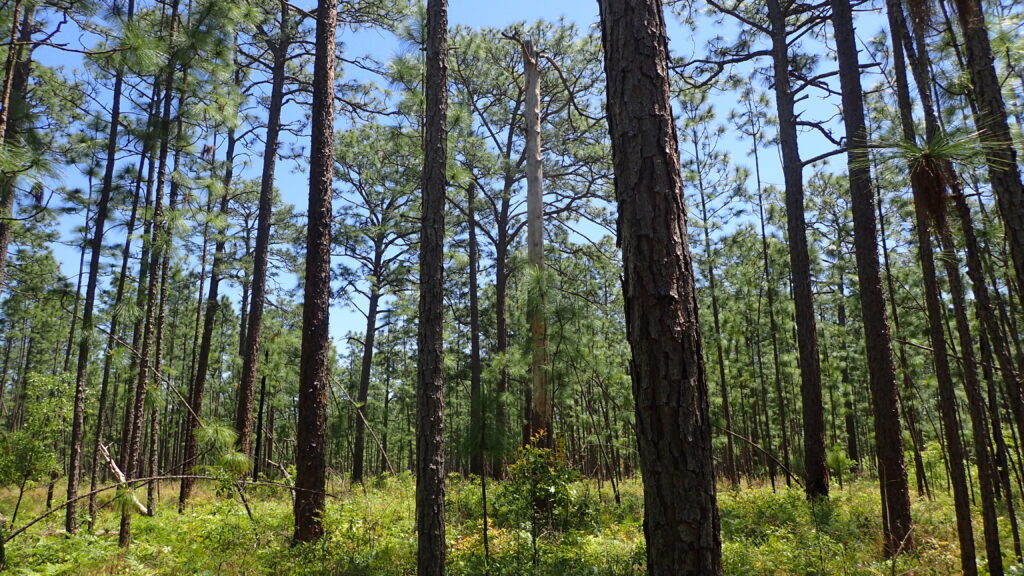
Resistance Treatment. Photo Credit: Joshua Puhlick.
  • Retain longleaf and cut other pines unless needed to maintain fuel continuity
  • Cut or girdle and herbicide hardwoods to enhance fuelbed characteristics
  • Prescribe burn every 2 years
  • Apply herbicide to hardwood stumps to discourage sprouting

Site Leads & Partners

Joshua Puhlick (The Jones Center at Ichauway) is the site lead for The Jones Center at Ichauway ASCC site. Key collaborators include Steven Brantley, Scott Taylor, Brandon Rutledge, and Scott Smith (The Jones Center at Ichauway). 

Joshua Puhlick
Site Lead

Ecological Silviculture
The Jones Center at Ichauway
3988 Jones Center Drive
Newton, GA 39870-8522
Phone: 229-734-4706
joshua.puhlick@jonesctr.org