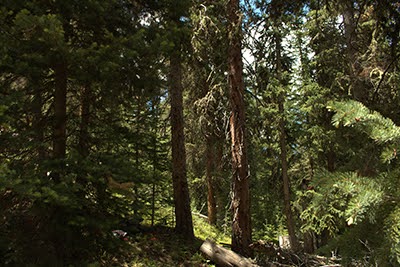
Treatment: allow some change in current conditions, but encourage eventual return to original conditions
Desired Future Conditions
The goal of this treatment is to begin promoting some future adapted species that already present on-site but are currently at low densities, while promoting Engelmann spruce and lodgepole pine over subalpine fir. The stand density will be reduced by removing ladder fuels; however, some snags and surface fuels will be left on site to promote wildlife habitat. The treatments will accommodate a disturbance frequency of 70-120 years to help promote species diversity and overall ecosystem resilience to wildfire, insects, diseases, and forest pests.
Conceptual diagram of the Resistance – Resilience – Transition (RRT) framework applied to the ASCC Network, positioned vertically along a spectrum of ecological persistence to change i.e., adaptation). The y-axis presents the degree of alignment with current conditions relative to the future range of acceptable outcomes (i.e., desired future conditions). Graphic by Kailey Marcinkowski, Northern Institute of Applied Climate Science.
Management Goals
All plots will regularly collect data to monitor reactions to each treatment.
Photo Credits: Angelika Helmer, Colorado State University.
Build resilience to drought, fire, white pine blister rust, windthrow, bark beetles
Promote future-adapted native tree species and genotypes (drought) to create multiple ways for vegetation development
Promote lodgepole pine for serotiny (fire resilience)
Create a heterogeneous structure and reduce fuels in the matrix
Promote wildlife habitat by retaining large diameter trees and snags
Provide ecosystem services, including wood products, watershed health, recreation opportunities, and cultural resources
Create opportunities for carbon sequestration by retaining larger trees
Strategies & approaches
Group selection to encourage lodgepole regeneration
Remove 20-30% of the basal area creating 3 2-acre groups and 3 1/2-acre groups
Place groups near overstory lodgepole pine to facilitate natural regeneration
Generally thin the matrix to promote healthier stands
Overall reduce the stand density by 10-20%
Remove Engelmann spruce <10” dbh, while maintaining mature/live spruce
Remove subalpine fir across all size classes >5″ dbh
Keep lodgepole pine and any Populus tremuloides (quaking aspen) present
Passively allow any natural regeneration to establish within matrix
Favor aspen and lodgepole pine in open areas
Plant Douglas-fir (local source) and rust-resistant limber pine
Map of seedlot locations and graph of mean annual precipitation and number of frost-free days.
The seedlots that will be used for Douglas-fir and limber pine reforestation in the resilience treatment will come from nearby populations, as shown on the maps. They both come from areas with average 1970’s climates that are drier and slightly warmer than the planting site, as indicated in the plots. The “period” corresponds to the climate projections for the average number of frost-free days and mean annual precipitation at the planting site in the 30 years centered on the 1970’s, 2020’s, 2050’s, and 2080’s. Numbers next to the seedlots on the map show the elevation in feet that the seedlot is from.
Maintain snags to help promote wildlife
Minimum of 4 snags/acre, retained in larger clumps if possible
Reduce ladder fuel build-up while leaving some to promote roughness, soil moisture, and nutrient cycling
Lop and scatter (20-35 tons/acre) to encourage lodgepole pine height growth and seedling survival during drought years. Allow for regeneration of spruce
Blair Rynearson, Zach Wehr, Carolina Manriquez, and John Twitchell from the Colorado State Forest Service are the site managers helping lead the Colorado State Forest ASCC Project. Mike Battaglia (Rocky Mountain Research Station) and Ethan Bucholz (Colorado State Forest Service) are scientists helping lead the research efforts for the site.
Key collaborators include Marin Chambers (Colorado Forest Restoration Institute) and Lance Asherin (USDA Forest Service Rocky Mountain Research Station, RMRS), Paula Fornwalt (USDA Forest Service Rocky Mountain Research Station, RMRS), Chuck Rhoades (USDA Forest Service Rocky Mountain Research Station, RMRS), Zachary Steel (USDA Forest Service Rocky Mountain Research Station, RMRS), Wade Tinkham (USDA Forest Service Rocky Mountain Research Station, RMRS), Katie Nigro (ORISE fellow working with the USDA Forest Service Rocky Mountain Research Station, RMRS), and the Forest and Rangeland Stewardship Department at Colorado State University.
Blair Rynearson Manager Site Lead
State Forest Manager
Colorado State Forest Service
59228 Highway 14
Walden, CO 80480
Phone: 970-723-4505
blair.rynearson@colostate.edu
Mike Battaglia Science Site Lead
Research Forester
Rocky Mountain Research Station, USDA Forest Service
Forest and Woodland Ecosystems Science Program
240 West Prospect Road
Fort Collins, CO 80526
Phone: 970-498-1286
michael.battaglia@usda.gov
Ethan Bucholz Site Lead
Forest Monitoring Program Manager
Colorado State Forest Service
3843 Laporte Ave.
Fort Collins, CO 80521
Phone: 314-757-0387
ethan.bucholz@colostate.edu