Robinson Forest - Transition

Treatment: actively facilitate change to encourage adaptive responses

Management Goals

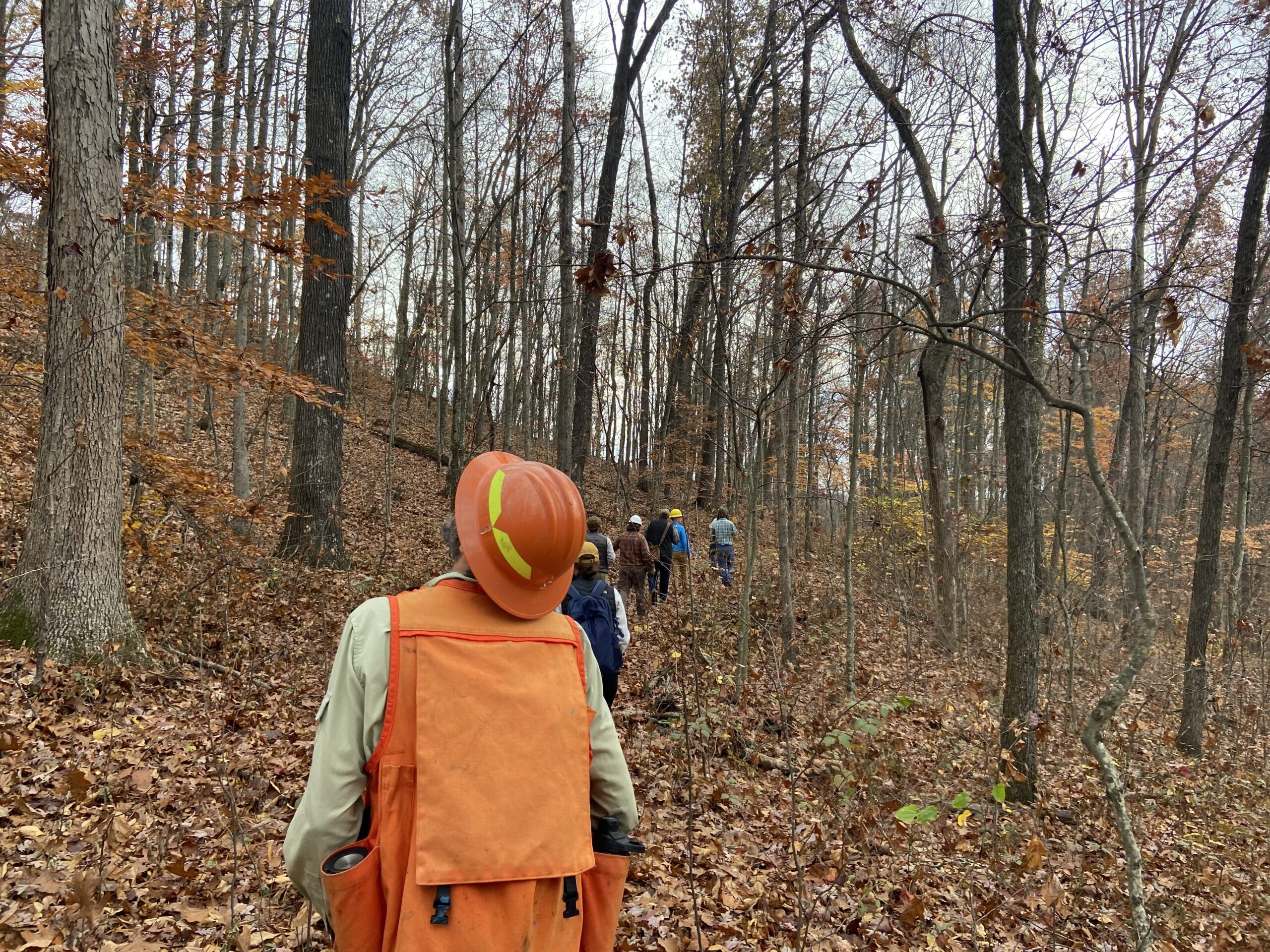
Forest in Autumn with leaves on the ground.
Hillside stand of trees at the Robinson Forest. Photo Credit: Jacob Muller, University of Kentucky.
  • Create a complex, variable structure with lower stocking rates of ~60%
  • Encourage a shift to a pine-oak dominated ecosystem with future-adapted native and novel species from warmer and drier climates
  • Increase microsite diversity

Strategies & approaches

  • Variable retention harvest to reduce stocking rates and provide opportunity for regeneration
  • Create a mosaic of non-uniform gaps to mimic disturbance ranging in size (0.5 to 1.5 acres) and frequency across treatment units.
  • Natural and artificial regeneration of species on site and novel species from warmer, drier North American climates to enhance climate adaptation to warmer temperatures, flash droughts, and flooding

Site Leads & Partners

Jacob Muller and John Lhotka (University of Kentucky) are the site leads for the Robinson Forest ASCC Site. Other key partners include The University of Kentucky Department of Forestry & Natural Resources, University of Kentucky Department of Plant & Soil Sciences, U.S. Department of Agriculture, U.S. Forest Service, Daniel Boone National Forest, Kentucky Natural Resources Conservation Service, Kentucky Division of Forestry, and the Kentucky Forest Industries Association.

Jacob Muller
Robinson Forest ASCC Site Lead

Assistant Professor of Hardwood Silviculture & Forest Operations Extension
University of Kentucky
730 Rose Street Lexington, KY 40546-0073
(859) 257-5666
jacob.muller@uky.edu

John Lhotka
Robinson Forest ASCC Site Co-Lead

Professor of Silviculture, Department of Forestry and Natural Resources
University of Kentucky
730 Rose Street Lexington, KY 40546-0073
(859) 257-9701
john.lhotka@uky.edu