
Southern New England Exurban Oak - Resilience

Treatment: allow some change in current conditions, but encourage eventual return to original conditions

Management Goals

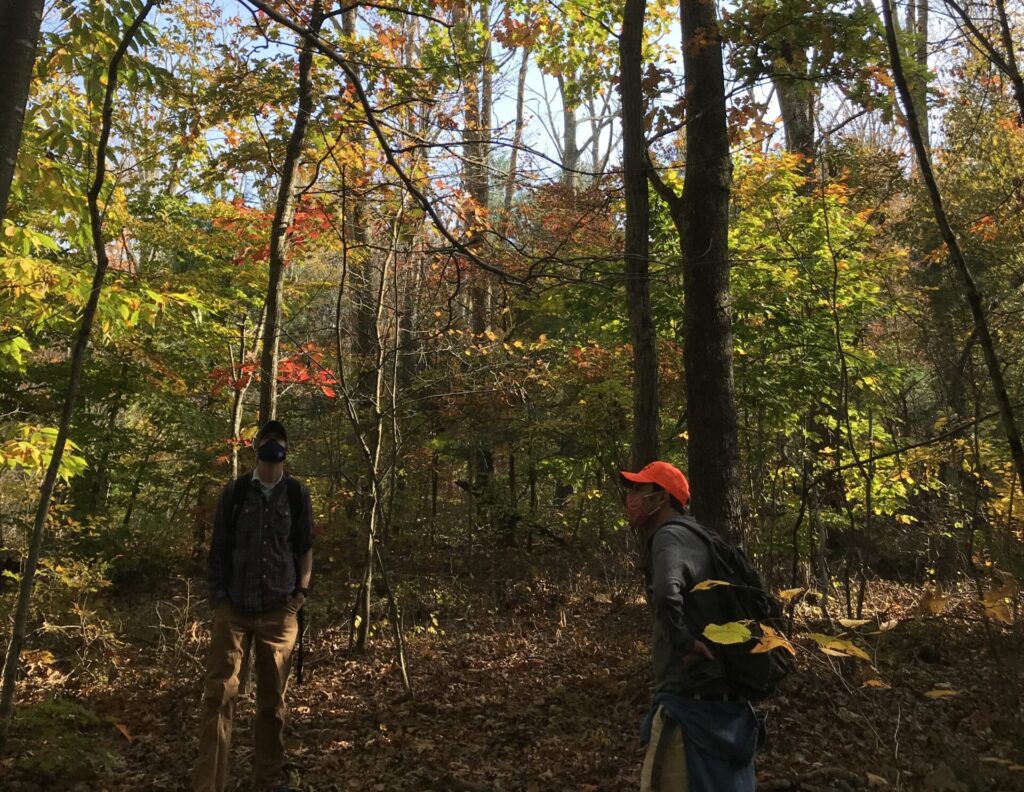
two people standing in a forested area in autumn.
Increase species and structural diversity characteristic will enable forest to respond to changing climate conditions.
Photo Credit: Amanda Bunce, University of Connecticut.
  • Increase species and structural diversity characteristic of this forest community to provide multiple pathways of recovery from disturbance
  • Increase the abundance of historically-native species that are adapted to future climate conditions and increased climate variability
  • Create multiple age classes that are spatially heterogeneous
  • Reintroduce fire as a natural disturbance when possible and increase the resilience of the forest to wildfire
  • Improve health and vigor of forest to a variety of insects and diseases (e.g, gypsy moth, forest caterpillar, etc.) and to reduce risk from drought
  • Reduce impacts from nonnative invasive plants and undesirable competing vegetation to facilitate future-adapted tree species

Strategies & approaches

  • Locate, treat, and remove invasive plant populations and reduce the abundance of other competitive vegetation prior to or in conjunction with any harvest treatments
  • Consider the use of prescribed fire or fire surrogates (e.g., flame torches) to control of invasive and competing vegetation and encourage oak and hickory
  • Create patch cuts to enhance advance regeneration and create light and growing conditions suitable for additional natural regeneration and planting
      • Openings should be at least ½ acre to allow for full sun in the center and a gradient of light conditions
      • Consider larger openings up to 2-5 acres in size where opportunities allow
      • Patches can be centered on areas of gypsy moth mortality when these conditions are present
      • Conduct a low thinning between patches to reduce density in these areas and increase the wind firmness of residual trees
  • Plant American chestnut and other tree species that were historically present and are expected to be adapted to future conditions
  • Protect planted and natural regeneration from deer herbivory
  • Retain wildlife trees and standing dead trees for habitat when they do not pose a safety hazard
  • Use hazardous trees to create dead downed wood when possible

Site Leads & Partners

Tom Worthley (University of Connecticut), Robert Fahey (University of Connecticut), and Christopher Riely (University of Rhode Island) are the Southern New England Exurban Oak Affiliate site leads. Anita Morzillo and Amanda Bunce (University of Connecticut) are the site co-leads. Key partners include the Connecticut Department of Energy and Environmental Protection, CT Division of Forestry, University of Rhode Island, the Rhode Island Department of Environmental Management, and Lee Farm.

Thomas Worthley
Southern New England Exurban Oak Affiliate, ASCC Site Lead

Associate Extension Professor, University of Connecticut Cooperative Extension Service
Forestry Sciences Laboratory, University of Connecticut Department of Natural Resources and the Environment
1376 Storrs Road, Unit 4066 Storrs,
CT 06269-4066
Phone: 860-345-5232
thomas.worthley@uconn.edu
Robert Fahey
Southern New England Exurban Oak Affiliate, ASCC Site Lead

Assistant Professor, University of Connecticut Department of Natural Resources and the Environment
1376 Storrs Rd. U-4087 Storrs, CT 06269-4087
Phone: 860-486-0148
robert.fahey@uconn.edu

Christopher Riely
Southern New England Exurban Oak Affiliate, DeCoppet Preserve, ASCC Site Lead

Research Associate IV, Forestry Specialist
Department of Natural Resources Science
USDA Natural Resources Conservation Service, Warwick RI
Phone: 401.822.8871
Email: criely@uri.edu