

this depicts oak mortality in the Decoppet Preserve replicate site.
Photo Credit: Christopher Riely, University of Rhode Island.
- Alter the forest community composition to an oak-hickory forest dominated by that contains a novel assemblage of future-adapted species
- Increase overall tree species diversity with a substantial component of native and novel future-adapted species and genotypes that are windfirm and drought-tolerant
- Create diverse canopy cover conditions over space and time that is heterogeneous for regeneration
- Promote age class diversity and structural complexity
- Increase proportion of stand in early successional stage of development, at least temporarily
- Improve health and vigor of forest to a variety of insects and diseases (e.g, gypsy moth, forest caterpillar, etc.) and to reduce risk from drought
- Reduce impacts from nonnative invasive plants and undesirable competing vegetation to facilitate future-adapted tree species
- Locate, treat, and remove invasive plant populations and reduce the abundance of other competitive vegetation prior to or in conjunction with any harvest treatment
- Consider the use of prescribed fire or fire surrogates (e.g., flame torches) to control of invasive and competing vegetation and encourage oak and hickory
- Create patch cuts or clear cuts with reserves to create light and growing conditions suitable for future-adapted planted tree
-
- Openings should be at least 2 acres to create early-successional conditions and areas suitable for planting novel assemblage
- Maintain reserves for structural heterogeneity, wildlife habitat, and locations for shade tolerant specie
- Feather edges to create a gradient of light condition
- Consider targeting species that are not expected to be adapted to future conditions for removal
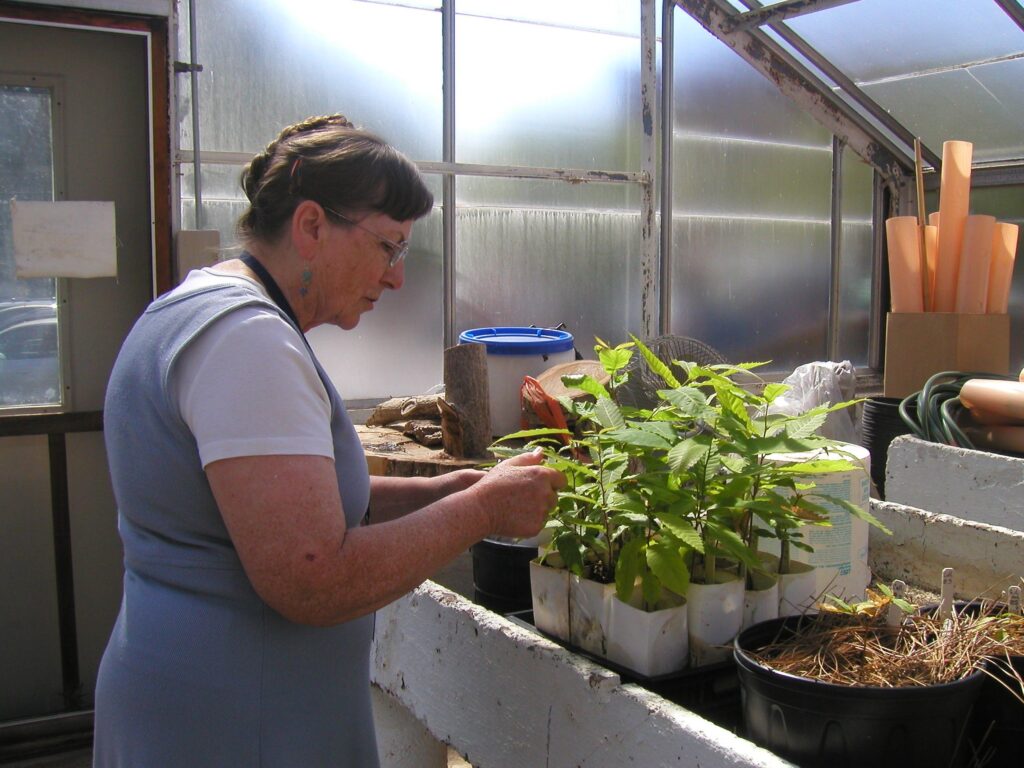
Dr. Sandra Anagnostakis growing chestnut trees at the Connecticut Agricultural Experimental Station
-
- Plant a variety of tree species that are expected to be adapted to future conditions and would create a novel assemblage in this location, including southern tree species and genotypes
- Protect planted trees from deer herbivore
- Retain wildlife trees and standing dead trees for habitat when they do not pose a safety hazard
- Use hazardous trees to create dead downed wood when possible


Thomas Worthley
Southern New England Exurban Oak Affiliate, ASCC Site Lead
Associate Extension Professor,
University of Connecticut Cooperative Extension Service
Forestry Sciences Laboratory,
University of Connecticut Department of Natural Resources and the Environment
1376 Storrs Road, Unit 4066
Storrs,
CT 06269-4066
Phone: 860-345-5232
thomas.worthley@uconn.edu
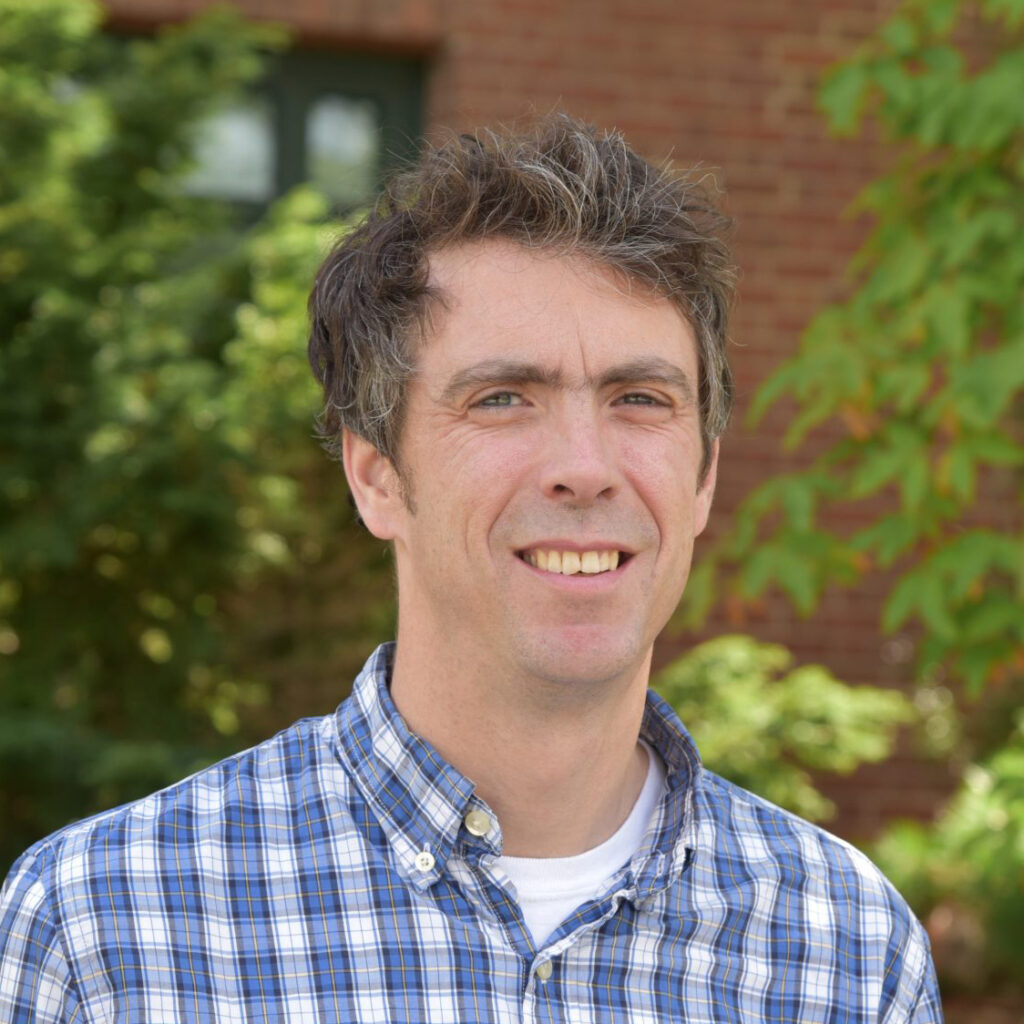
Robert Fahey
Southern New England Exurban Oak Affiliate, ASCC Site Lead
Assistant Professor,
University of Connecticut Department of Natural Resources and the Environment
1376 Storrs Rd. U-4087
Storrs, CT 06269-4087
Phone: 860-486-0148
robert.fahey@uconn.edu

Christopher Riely
Southern New England Exurban Oak Affiliate, DeCoppet Preserve, ASCC Site Lead
Research Associate IV, Forestry Specialist
Department of Natural Resources Science
USDA Natural Resources Conservation Service, Warwick RI
Phone: 401.822.8871
Email: criely@uri.edu