
Southern New England Exurban Oak - Resistance

Treatment: maintain relatively unchanged conditions over time

Management Goals

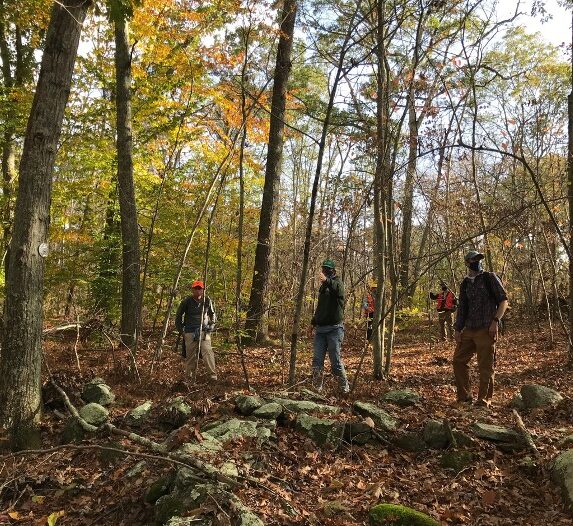
Three people taking a tour of the Mohegan State Forest.
Site tour of the Mohegan State Forest. Photo Credit: Amanda Bunce, University of Connecticut.
  • Maintain current composition and structure with oak dominance with current components of hickory, but also including shade tolerant species and minor species such as hemlock
  • Maintain a fully-stocked stand
  • Initiate regeneration that reflects the current species composition
  • Maintain or reduce impacts from forest pests, insects, disease, and invasives
  • Reduce competing understory vegetation to promote regeneration
  • Protect key ecological and physical characteristics of the site
  • Retain habitat features, such as dead wood, to support the current assemblage of birds and other wildlife

Strategies & approaches

  • Locate, treat, and remove invasive plant populations and reduce the abundance of other competitive vegetation prior to any harvest treatments
  • Implement a 3-stage shelterwood harvest:
      • Preparatory treatment to tend any regeneration that has established in the most recent disturbance event, create opportunities to establish new regeneration for oak and hickory, and  increase crown space around residual trees to increase vigor and value
      • Shelterwood cut to reduce stand density and facilitate growth of new regeneration
      • Overstory removal (partial or complete) at 20-30 years into the future to maintain conditions suitable for the desired regrowth
  • Create reserves within the shelterwood to protect key features:
      • Areas with rare species, sensitive sites, or recreational areas for reserves
      • Areas that are topographically sheltered (less vulnerable to windthrow)
  • Retain wildlife trees and standing dead trees for habitat when they do not pose a safety hazard
  • Use hazardous trees to create dead downed wood when possible

Site Leads & Partners

Tom Worthley (University of Connecticut), Robert Fahey (University of Connecticut), and Christopher Riely (University of Rhode Island) are the Southern New England Exurban Oak Affiliate site leads. Anita Morzillo and Amanda Bunce (University of Connecticut) are the site co-leads. Key partners include the Connecticut Department of Energy and Environmental Protection, CT Division of Forestry, University of Rhode Island, the Rhode Island Department of Environmental Management, and Lee Farm.

Thomas Worthley
Southern New England Exurban Oak Affiliate, ASCC Site Lead

Associate Extension Professor, University of Connecticut Cooperative Extension Service
Forestry Sciences Laboratory, University of Connecticut Department of Natural Resources and the Environment
1376 Storrs Road, Unit 4066 Storrs,
CT 06269-4066
Phone: 860-345-5232
thomas.worthley@uconn.edu

Robert Fahey
Southern New England Exurban Oak Affiliate, ASCC Site Lead

Assistant Professor, University of Connecticut Department of Natural Resources and the Environment
1376 Storrs Rd. U-4087 Storrs, CT 06269-4087
Phone: 860-486-0148
robert.fahey@uconn.edu

Christopher Riely
Southern New England Exurban Oak Affiliate, DeCoppet Preserve, ASCC Site Lead

Research Associate IV, Forestry Specialist
Department of Natural Resources Science
USDA Natural Resources Conservation Service, Warwick RI
Phone: 401.822.8871
Email: criely@uri.edu